Sokushinbutsu, JAPAN Sokushinbutsu(即身仏) were Buddhist monks or priests who caused their own deaths in a way that resulted in their mummification. This practice reportedly took place almost exclusively in northern Japan around the Yamagata Prefecture. It is believed that many hundreds of monks tried, but only between 16 and 24 such mummifications have been discovered to date. The practice is not advocated or practised today by any Buddhist sect.
Procedure
This is juku Bosatsu Shinnyokai Shonin
who died in 1783
Pic by barista
For 1,000 days (a little less than three years) the priests would eat a special diet consisting only of nuts and seeds, while taking part in a regimen of rigorous physical activity that stripped them of their body fat. They then ate only bark and roots for another thousand days and began drinking a poisonous tea made from the sap of the Urushi tree, normally used to lacquer bowls.
This caused vomiting and a rapid loss of bodily fluids, and most importantly, it made the body too poisonous to be eaten by maggots. Finally, a self-mummifying monk would lock himself in a stone tomb barely larger than his body, where he would not move from the lotus position. His only connection to the outside world was an air tube and a bell. Each day he rang a bell to let those outside know that he was still alive.
When the bell stopped ringing, the tube was removed and the tomb sealed. After the tomb was sealed, the other monks in the temple would wait another 1,000 days, and open the tomb to see if the mummification was successful.
While foreigners might think Sokushinbutsu monks had to be mad to go through such a long and painful process just to eventually kill themselves, they were actually raised to the status of Buddha and revered in Shingon temples across northern Japan. To them, this reward was more than enough.
If the monk had been successfully mummified, they were immediately seen as a Buddha and put in the temple for viewing. Usually, though, there was just a decomposed body. Although they were not viewed as a true Buddha if they were not mummified, they were still admired and revered for their dedication and spirit.
As to the origin of this practice, there is a common suggestion that Shingon school founder Kukai brought this practice from Tang China as part of secret tantric practices he learned, and that were later lost in China.
The practice was satirized in the story "The Destiny That Spanned Two Lifetimes" by Ueda Akinari, in which such a monk was found centuries later and resuscitated. The story appears in the collection Harusame Monogatari.
Until it was outlawed, in the late 18th century, it is believed hundreds of monks attempted to become Sokushinbutsu, but many of them failed. As mentioned earlier, only between 16 and 24 Sokushinbutsu mummies have been discovered in Japan. The most famous is Shinnyokai Shonin of the Dainichi-Boo Temple on the holy Mount Yudono. The majority of the monks who underwent self-mummification did so near this temple. It has been shown that a local spring had high levels of arsenic, and this may have helped the monks in the mummification process. Others can be found in more banal locations such as in Nangakuji Temple, in the suburbs of Tsuruoka, and at Kaikokuji Temple in the small city of Sakata.
Although this practice has been illegal for sometime now, a new Sokushinbutsu was discovered in July 2010, right in Tokyo.
Drigung Monastery, Tibetan monastery famous for performing sky burials Pic by Wiki user Davin7
Tibet, known as ‘the Roof of the World’, is a jewel in the Himalayas and is the traditional homeland of the Tibetan people as well as some other ethnic groups such as Monpas, Qiang, and Lhobas, and is inhabited by considerable numbers of Han and Hui people. Tibet is the highest region on earth, with an average elevation of 4,900 metres (16,000 ft).
One fascinating part of the Tibetian culture is the Sky Burial or ritual dissection - a common funerary practice in Tibet wherein a human corpse is cut in specific locations and placed on a mountaintop, exposing it to the elements or the mahabhuta and animals – especially to birds of prey. In Tibet the practice is known as jhator which literally means, "giving alms to the birds."
The majority of Tibetans adhere to Buddhism, which teaches rebirth. There is no need to preserve the body, as it is now an empty vessel. Birds may eat it, or nature may let it decompose. So the function of the sky burial is simply the disposal of the remains. In much of Tibet the ground is too hard and rocky to dig a grave, and with fuel and timber scarce, a sky burial is often more practical than cremation.
The Tibetan sky-burial practices appear to have evolved out of practical considerations. Most of Tibet is above the tree line, and the scarcity of timber makes cremation economically unfeasible. Additionally, subsurface interment is difficult since the active layer is not more than a few centimeters deep, with solid rock or permafrost beneath them. A traditional jhator is performed in specified locations in Tibet (and surrounding areas traditionally occupied by Tibetans). Drigung Monastery is one of the three most important jhator sites.
The procedure takes place on a large flat rock long used for the purpose. The charnel ground (durtro) is always higher than its surroundings. It may be very simple, consisting only of the flat rock, or it may be more elaborate, incorporating temples and stupa (chorten in Tibetan).
Relatives may remain nearby during the jhator, possibly in a place where they cannot see it directly. The jhator usually takes place at dawn.
The full jhator procedure (as described below) is elaborate and expensive. Those who cannot afford it simply place their deceased on a high rock where the body decomposes or is eaten by birds and animals.
Procedure
Accounts vary from one observer to the next. The following description is assembled from multiple accounts by observers from the U.S. and Europe.
Participants
Prior to the procedure, monks may chant mantra around the body and burn juniper incense – although ceremonial activities often take place on the preceding day.
The work of disassembling of the body may be done by a monk, or, more commonly, by rogyapas ("body-breakers").
All the eyewitness accounts remarked on the fact that the rogyapas did not perform their task with gravity or ceremony, but rather talked and laughed as during any other type of physical labor. According to Buddhist teaching, this makes it easier for the soul of the deceased to move on from the uncertain plane between life and death onto the next life.
In most accounts, vultures are given the whole body. When only the bones remained, they are broken up with mallets, ground with tsampa (barley flour with tea and yak butter or milk), and given to crows and hawks that have waited until the vultures had departed.
In several accounts, the flesh was stripped from the bones and given to vultures without further preparation; the bones then were broken up with sledgehammers, and usually mixed with tsampa before being given to the vultures. Many rogyapa first feed the bones and cartilage to the vultures, keeping the best flesh until last. After having had their fill of good quality meat, the birds usually fly away - leaving the bones and less favored bits.
In one account, the leading rogyapa cut off the limbs and hacked the body to pieces, handing each part to his assistants, who used rocks to pound the flesh and bones together to a pulp, which they mixed with tsampa before the vultures were summoned to eat.
Sometimes the internal organs were removed and processed separately, but they too were consumed by birds. The hair is removed from the head and may be simply thrown away; at Drigung it seems at least some hair is kept in a room of the monastery.
None of the eyewitness accounts specifies what kind of knife is used in the jhator. One source states that it is a "ritual flaying knife" or trigu (Sanskritkartika), but another source expresses scepticism, noting that the trigu is considered a woman's tool (rogyapas seem to be exclusively male).
In places where there are several jhator offerings each day, the birds sometimes had to be coaxed to eat, which in one case was accomplished by a ritual dance. It is considered a bad omen if the vultures will not eat, or if even a small portion of the body is left after the birds fly away.
In places where fewer bodies are processed, the vultures were more eager and sometimes had to be fended off with sticks during the initial preparations.
A great deal of you may have heard of this ritual before, but for those of you who haven't, here are photos capturing the experience by photographer Bram...
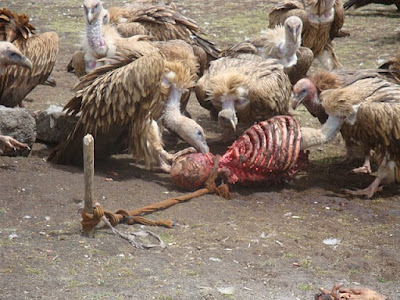
They hammer a pole into the ground and tie you to the pole head first, otherwise the vulture takes off with the whole body and this is not the intention. Afterwards, the family starts cutting open the body so that the vultures can start their job.
It's his own family who is mutilating the body.
You can see the heads of the vultures becoming red.
100 meters further away, there's another 'funeral' on its way. this one is being executed by the official cutter. This man does this as a living. some families do prefer to do it themselves.
Vultures fighting over a bit of tendon.
Uiteindelijk is al het vlees eraf en beginnen ze aan de tweede ronde Ultimately, all the meat is gone and they start with the second round.
Here starts the second part, all axes, sledgehammers and knives are surfacing. Once the vultures are gone and have eaten all the meat (which took about 20 mins.), only the skeleton and the skull is left. They chase the vultures and start breaking the bones. They mix the bones with the brains until they have like a whitish gray paste which you can see laying in front of the stone. This is being fed again to the vultures. In the end, nothing, absolutely nothing is left of the whole body.
Even the hair, the eyeballs and head-skin is eaten by the vultures.
The last picture with his brother before he smashes his skull.
He 'plays' a bit with the brain before they are mixed with crushed bones mixture that is eventually fed to the vultures. All this being done with bare hands.
Nothing is left of the body. Everything has been given back to nature....
"Sky burial and open cremation may initially appear grotesque for Westerners, especially if they have not reflected on their own burial practice. For Tibetan Buddhists, sky burial and cremation are templates of instructional teaching on the impermanence of life."
Jhator is considered an act of generosity on the part of the deceased, since the deceased and his/her surviving relatives are providing food to sustain living beings. Generosity and compassion for all beings are important virtues or paramita in Buddhism.
The government of the People's Republic of China, which has controlled Tibet since 1950, prohibited the practice (which it considered barbaric) in the 1960s but started to allow it again in the 1980s. People who do not know the deceased usually do not observe it.