Showing posts with label Soviet Union. Show all posts

Sunday, June 26, 2011

⅏Did You Know: The "Ninth Fort" Massacres


Did You Know...

On June 25, 1940, hundreds of Kovno Jews are taken to the "Ninth Fort" and murdered?

The Ninth Fort, 1944

The Ninth Fort in Kaunas, Lithuania was originally built as a defensive fortress in the years 1901–1913. During the Nazi occupation, over 50,000 people were executed there, including over 30,000 Jews and over 10,000 foreigners.
Jews inside the Ninth Fort,
immediately after their arrival there
and prior to their execution
In secret the Nazis called it Vernichtungsstelle Nr 2 – Extermination place number 2. Here were murdered some 25,000 of Kovno’s Jews, as well as 15,000 Jews deported from the Greater Reich, thousands of Jewish Prisoners – of – War who had served in the Red Army, and many other Jews. 

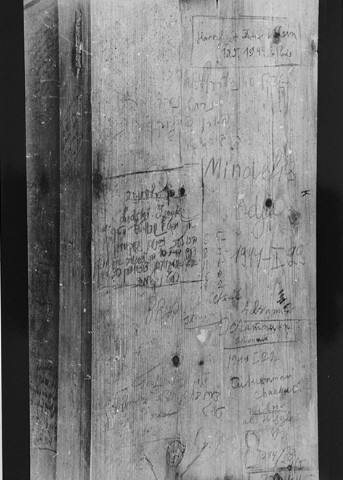
Before their execution, the detainees were incarcerated in underground cells known as “casements” in damp, darkness, and fear. There, people fought with one another for a brighter corner in the cells, for a piece of a straw mattress, for a scrap of food, or for a crumb of bread. There, Jews were shackled in iron chains, harnessed to ploughs in place of horses, forced to dig into peat-pits inside the fort, and often whipped to death. There, one soon lost one’s own – there, life turned into senseless pain, after which death came as redemption.
Jewish prisoners on a wall
 inside Fort IX,
shortly before their execution
Keidan a father of four children was incarcerated at the Fort and tortured there for five months. With others he stood naked in the pit awaiting execution, and somehow miraculously escaped from the Fort. He was the first to bring an authentic report from the Hell on Earth. In fifteen mass pits, some 45,000 innocent victims found their awful burial, 3,000 in each pit. Thousands of Red Army Prisoners-of-War, all Jews were separated from the other Soviet Prisoners-of- War and were systematically massacred at the Ninth Fort. 

In August 1943 the Kovno Gestapo received orders from Berlin to eradicate the mass graves – to exhume the corpses and to burn them. This was to be carried out by the end of January 1944, when the German retreat from the Baltic States was foreseen. The carrying out of this order was imposed upon seventy-five Jews who were already imprisoned at the Fort, among them Ghetto inmates who had been seized in the Ghetto and brought to the Fort, Red Army Prisoners–of–War, and youngsters from the Ghetto, who had been caught on their way to join partisans in the forest.

Kovno, Lithuania, Mass graves
at the Ninth Fort
Eleven of the seventy-five declared at the outset they were ill, and not capable of doing the job. The Gestapo murdered them by injections of poison. The remaining sixty –four, sixty men and four women formed a labour squad. All of them, apart from one Polish woman, were Jews. 

The work started in September 1943.  The sixty-four were divided into four groups, each of which carried out a part of the job. One group “the diggers” had to dig out the dead corpses – to scrape off the upper layer of the earth from the pits, and then, with spades, remove the first layers of the corpses. This group had to go down into the pit by ladder and, using pitchforks, toss the remaining bodies up to the surface.

All valuables had to be cleaned and polished and handed over to the German supervisors. Most of the corpses were half or totally decayed, but some were well preserved. More than once, the diggers recognised their own acquaintances. On one occasion, a digger recognised his brother.

Not one of the sixty-four prisoners believed he would remain alive  once the job was done. They were reminded morning and evening, day and night, that nobody had ever escaped from the Ninth Fort. 


Monument and Memorial
for Victims of Nazi Atrocities
It was the careful and meticulous planning of prisoner, Captain Kolia Vassilenko, who was brought to the Fort from the Soviet prisoner-of-war camp near Kalvaria, that aided in their freedom.  Vassilenko had been regarded as a Russian until he was compelled to go to the bathhouse, and was discovered to be a Jew.

All the prisoners managed to escape the fortress without being discovered and fled to locations they had decided on in advance.
When morning arrived, the Germans returned to the fortress and found it empty. They called for reinforcements and began a manhunt. All except three of the prisoners who had escaped to the forest were caught.

After they reached freedom, Vassilenko and a number of the escapees made their way to Kovno Ghetto where he gave details of the escape and how in1943 how the Germans carried out the murder of the family of Chief Rabbi Shapiro.
The fugitives also brought with them evidence and materials they had collected in and around the graves during the excavations. “Let them be given to relatives in the Ghetto, to let them know for whom there is no point in waiting any longer.”
Vassilenko told us – the group had also brought with them the gold teeth of some of the slain – the gold weighed a quarter of a kilogram. The other groups had also taken documents and valuables with them.

also

Did You Know?  For the month of


back in.....

  • 1807, Jun 26, Lightning Strikes in Luxembourg.  On this day in 1807, lightning hits a gunpowder factory in the small European country of Luxembourg, killing more than 300 people. Lightning kills approximately 73 people every year in the United States alone, but victims are almost always killed one at a time. The Luxembourg disaster may have been the most deadly lightning strike in history.
  • 1957, Jun 26, A Serial Killer Preys Upon a Woman Out for a Drive.  Margaret Harold is shot and killed while out for a drive with her boyfriend near Annapolis, Maryland.  Her killer swerved in front of the couple's car, approached with a .38 revolver, and shot Harold in the side of the face, while her boyfriend managed to escape.  Investigating police found an abandoned building nearby, filled with pornographic pictures, but its full significance would not be revealed until nearly two years later.
Tips evenutally pointed towards Melvin Rees, a piano salesman working in West Memphis.


Detectives found evidence that linked Rees to the slayings of four other young women in the Maryland area as well.  Rees was tried in February 1961 for the murder of Margaret Harold and in September 1961 for the murders of the Jackson family; he was convicted of both and sentenced to death.  His sentence was commuted to life imprisonment in 1972, and he died in prison from heart failure in 1995.
  • 1971, Jun 30, Soviet Cosmonauts Perish in Re-entry Disaster.  Three Soviet cosmonauts, Georgi Dobrovolsky, Vladislav Volkov, and Viktor Patsayev who served as the first crew of the world's first space station die when their spacecraft depressurizes during reentry.
On June 6, the cosmonauts were launched into space aboard Soyuz 11 on a mission to dock and enter Salyut 1, the Soviet space station that had been placed in orbit in April which they accomplished and spent 23 dys orbiting the earth.  On June 30, they left Salyut 1 and began reentry procedures. When they fired the explosive bolts to separate the Soyuz 11 reentry capsule from another stage of the spacecraft, a critical valve was jerked open.
A 1971 Stamp commemorating
 the memory of 3 cosmonauts
 (Georgi Dobrovolsky, Vladislav Volkov,
and Viktor Patsayev)

One hundred miles above the earth, the capsule was suddenly exposed to the nearly pressureless environment of space. As the capsule rapidly depressurized, Patsayev tried to close the valve by hand but failed. Minutes later, the cosmonauts were dead. As a result of the tragedy, the Soviet Union did not send any future crews to Salyut 1, and it was more than two years before they attempted another manned mission.
  • 1975, Jun 28, A Teenage Girl's Boyfriend Murders her Parents.  Police are called to the home of Jim and Naomi Olive in Terra Linda, California, after Jim Olive's business partner reports that the couple has not been seen in a week.  Marlene turned up at the police station later that day and began telling a bizarre series of stories explaining her parent's disappearance.  Eventually she led detectives to a fire pit outside the town where the burned remains of her parents were located.  With a little investigation, the detectives found out about Chuck Riley, Marlene's boyfriend. At his home was an unopened letter from Marlene that read, "I have no guilty feelings at all about my folks. NONE. NEITHER SHOULD YOU. Relax."
Because she was a teenager at the time of the murders, Marlene Olive served only four years before being released from prison in 1979. Riley was given a death sentence that was later commuted to life imprisonment.

  • 1976, Jun 27, Ebola Breaks Out in Sudan.  A factory storekeeper in the Nzara township of Sudan becomes ill on this day in 1976.   Five days later, he dies, and the world's first recorded Ebola virus epidemic begins making its way through the area. By the time the epidemic is over, 284 cases are reported, with about half of the victims dying from the disease.
After the storekeeper in Nzara died, a second man in town died on July 6. His brother became sick soon after, but managed to recover. The brother's co-worker went to the hospital on July 12 with symptoms and was dead two days later; the co-worker's wife died five days after that. A week later a male neighbor died. Eventually, another 48 infections and 27 deaths were traced back to the neighbor.
Given this pattern of infection and the fact that hospital workers also started to develop symptoms, doctors realized that transmission of the virus required only close contact. At Maridi Hospital in southern Sudan, 33 of the 61 nurses ended up dead from Ebola fever
The World Health Organization finally arrived in October and helped to contain the epidemic.   Scientists still do not know what causes the disease or how to cure it.
  • 1988, June 27, Tyson knocks out Spinks.  On this day in history, heavyweight champion Mike Tyson (the only heavyweight boxer to hold the WBA, WBC and IBF titles simultaneously), knocks out challenger Michael Spinks 91 seconds into the first round. The decisive victory left the boxing world wondering if anyone could beat "Iron Mike" Tyson.
Mike Tyson at SXSW 2011
Pic by Wiki user Karppinen
Tyson was discovered by legendary boxing trainer Cus D’Amato. D’Amato became a father figure to "Iron" Mike and a stabilizing force in his life: He took the young fighter into his home and dedicated himself to Tyson’s training. D’Amato helped Tyson to focus his aggression and develop the discipline to become a champion. 

One of Tyson's trademark combinations was to throw a right hook to his opponent's body, then follow it up with a right uppercut to his opponent's chin; very few boxers would remain standing if caught by this combination

After Larry Holmes, Michael Spinks was considered the only boxer with a chance against Tyson.  Spinks outmaneuvered the bigger but older Holmes on his way to a 15-round decision and the IBF heavyweight belt on September 21, 1985. In the rematch a year later, Spinks won again.

Spinks was knocked out 91 seconds into the biggest payday and worst beating of his career and he never fought again.

On June 11, 2005, Tyson stunned the boxing world by quitting before the start of the seventh round in a close bout against journeyman Kevin McBride. After losing the third of his last four fights, Tyson said he would quit boxing because he no longer had "the fighting guts or the heart anymore."
  • 1997, Jun 28, Mike Tyson Bites Ear.  Mike Tyson bites Evander Holyfield’s ear in the third round of their heavyweight rematch. The attack led to his disqualification from the match and suspension from boxing, and was the strangest chapter yet in the champion’s roller-coaster career.


Resources:

Sunday, June 5, 2011

⅏Did You Know: Barbara Graham aka "Bloody Babs"


Did You Know...

Barbara Graham takes what may be
the last look at her son Tommy,
18 months old, in
Los Angeles Jail
On June 3rd, 1955, Barbara Graham was gassed at California’s San Quentin Prison, along with two confederates in the brutal murder of an elderly widow. 

Barbara Graham (June 26, 1923 – June 3, 1955) was an American criminal and convicted murderess. She was executed in the gas chamber on the same day as two convicted accomplices, Jack Santo and Emmett Perkins. Nicknamed "Bloody Babs" by the press, Graham was the third woman in California to die by gas.


Graham was born Barbara Elaine Wood in Oakland, California. When Barbara was two, her mother, who was a teenager, was sent to reform school. Barbara was raised by strangers and extended family, and had a limited education. As a teenager, she was arrested for vagrancy and was sentenced to serve time at Ventura State School for Girls the same reform school where her mother had been.
Released from reform school in 1939, Barbara tried to make a new start for herself. She married and enrolled in a business college and soon had her first child. The marriage was not a success, and by 1941 she was divorced. Over the next several years, she was married twice more and had a second child, but each of these attempts at a normal life failed.

After this string of failures, Barbara is said to have become a prostitute, during World War II, she was a "seagull" working near the Oakland Army Base, Oakland Navy Supply Base and the Alameda Naval Air Station   In 1942, she and some other "seagulls" flew down to Long Beach and San Diego. She was arrested on vice charges in these naval cities and in San Pedro. 

Barbara liked nice things and also, perhaps surprisingly, was said to enjoy classical music but she also liked gambling and drugs.  At 22, with her good looks, red hair and sex appeal she was working for a time in San Francisco for brothel madame Sally Stanford. She was soon involved in drugs and gambling and had a number of friends who were ex-convicts and career criminals. She served five years for perjury as an alibi witness for two petty criminals. She served her sentence at the California Department of Corrections, Womens State Prison at Tehachapi. After her stint in state prison, Barbara moved to Reno, Nevada and then Tonopah.   In another attempt to live a decent life, she worked in a hospital and as a waitress. Barbara became bored and got on a bus for Los Angeles. She got a room on Hollywood Boulevard and returned to prostitution.

The Crime
In 1953, she married a bartender, Henry Graham, with whom she had a third child, named Tommy who was two years old at the time of her execution.  Unfortunately, Graham was a hardened criminal and drug addict with low-life friends, and it was through him Barbara met his criminal friends Emmet Perkins and Jack Santo.   She started an affair with Perkins, who told her about a 64-year-old widow, Mabel Monohan, who was rumored to keep a large amount of cash in her home in Burbank.
In March 1953, Barbara joined Perkins and Santo, as well as John True and Baxter Shorter (two of their associates), in robbing Monohan's home in Burbank. Barbara reportedly gained entry by asking to use her phone. Once Monohan opened the door for Graham, the three men burst in. The gang demanded money and the jewels from Monohan, but she refused to give them anything. At this point, Barbara reportedly pistol-whipped Monohan, cracking her skull. They then suffocated her with a pillow.
The robbery attempt was a futile effort; the gang found nothing of value in the house and left empty-handed. They later learned that they had missed about $15,000 in jewels and valuables stashed in a purse in the closet near where they had murdered Monohan.


Arrest and Conviction
Eventually, some of the gang members were arrested and John True agreed to become a state witness in exchange for immunity from prosecution. In court, True testified against Graham, who continually protested her innocence. Graham apparently stood a good chance of being acquitted, but erred by offering another inmate $25,000 to hire a "friend" who would provide an alibi. When questioned about her actions at the trial, she said, "Oh, have you ever been desperate? Do you know what it means not to know what to do?" Graham was ultimately convicted.

Execution

Inside the California chamber are two
identical metal chairs with perforated seats,
marked "A" and "B."
 (The twin chairs were last used in a
double execution in 1962).
Graham, Santo, and Perkins were all sentenced to death for the robbery and murder. Graham appealed against her sentence while serving time at the California Institute for Women in the city of Corona. Her appeals failed, and she was transferred to the death row at San Quentin State Prison to await execution. On June 3, 1955, she was scheduled to be executed at 10:00 a.m., but that was stayed by California governor Goodwin J. Knight until 10:45 a.m. At 10:43 a.m., the execution was stayed by Knight again until 11:30 a.m., and a weary Graham protested, "Why do they torture me? I was ready to go at ten o'clock." At 11:28 a.m., Graham was led from her cell to be strapped in the gas chamber. There, she requested a blindfold so she wouldn't have to look at the observers. Her last words were "Good people are always so sure they're right."

After Graham's death her life story was made into a movie called, "I Want to Live!" and starred Susan Hayward, who later won an Academy Award for playing Graham in the film.


Graham was also portrayed by actress Lindsay Wagner (above), in a 1983 TV version of I Want to Live!


The GAS CHAMBER!
While I was doing this story, I was also curious about this gas chamber in California.  How do they actually get them ready for it?  How does the gas affect them?  Does it hurt or is it painless?  The video above gave us great insight as to what really happened before and during execution.  But I still was curious and wanted to know and understand better what it is I was really seeing.
Did you know?...
The Procedure

  1. Two guards strap the prisoner into chair A, attaching straps across his upper and lower legs, arms, thighs and chest.
  2. They affix a Bowles stethoscope to the person's chest so that a doctor on the outside can monitor the heartbeat and pronounce death.
  3. Beneath the chair is a bowl filled with sulphuric acid mixed with distilled water to give a concentration of approximately 37%, with a pound of sodium cyanide pellets suspended in a gauze bag just above.
  4. After the door is sealed, and when the warden gives the signal, the executioner in a separate room operates a lever that releases the cyanide into the liquid. This causes a chemical reaction that releases hydrogen cyanide gas, which rises through the holes in the chair.
  5. When the reaction has finished the gas reaches a concentration of around 7,500 ppm.
Prisoners are advised to take deep breaths after the gas is released as this will considerably shorten their suffering. Easy for the Warden to say, no doubt, but much harder for the prisoner to intentionally inhale the gas designed to kill them even if they accept the logic of the advice they are given.
The Actual Process
A typical witnesses view of gassing is as follows: 
  • In medical terms, victims of cyanide gas die from hypoxia, which means the cut off of oxygen to the brain.
  • The initial result of this is spasms, as in an epileptic seizure. Because of the straps, however, involuntary body movements are restrained.
  • Seconds after the prisoner first inhales, he/she will feel himself unable to breathe, but will not lose consciousness immediately. "The person is unquestionably experiencing pain and extreme anxiety," according to Dr. Richard Traystman of Johns Hopkins University.
  • The pain begins immediately and is felt in the arms, shoulders, back, and chest.
  • The sensation is similar to the pain felt by a person during a heart attack, where essentially the heart is being deprived of oxygen." Traystman added: "We would not use asphyxiation, by cyanide gas or by any other substance, in our laboratory to kill animals that have been used in experiments."
Did You Know?...
A study of the execution records of 113 prisoners executed at San Quentin showed that the average time taken to kill them was 9.3 minutes. The prisoner will usually lose consciousness between one and three minutes after the gas hits their face and the doctor will pronounce them dead in around 10 to 12 minutes. An exhaust fan then sucks the gas out of the chamber. Next, the corpse is sprayed with ammonia, which neutralises traces of the cyanide that may remain. After about half an hour, staff enter the chamber, wearing gas masks and rubber gloves. Their training manual advises them to ruffle the victim's hair to release and trapped cyanide gas before removing him.

also

Did You Know?  For the month of


back in.....

  • 1934, Jun 01, Nissan Motor Company Found.  On this day in 1934, the Tokyo-based Jidosha-Seizo Kabushiki-Kaisha (Automobile Manufacturing Co., Ltd. in English) takes on a new name: Nissan Motor Company.
  • 1953, Jun 02, Coronation of Queen Elizabeth II.  Queen Elizabeth II is formally crowned monarch of the United Kingdom in a lavish ceremony steeped in traditions that date back a millennium. A thousand dignitaries and guests attended the coronation at London's Westminster Abbey, and hundreds of millions listened on radio and for the first time watched the proceedings on live television. After the ceremony, millions of rain-drenched spectators cheered the 27-year-old queen and her husband, the 30-year-old duke of Edinburgh, as they passed along a five-mile procession route in a gilded horse-drawn carriage.
  • 1965, Jun 01, Coal Mine Explosion Killed 236 in Japan.  Coal mine explosion kills 236 workers at the Yamano mine near Fukuoka, Japan, on this day.  The tragic disaster might have been avoided if the operators of the mine had taken even the most basic safety precautions.
  • The sudden explosion, probably brought about by the ignition of a gas pocket, led to the collapse of many of the mine shafts and caused boulders to block the escape routes.  For the next two days, thousands of relatives and friends waited outside the mine as the rescue effort got underway. But the wait was futile; no survivors were found. Yoshio Sakarauchi, the trade and industries minister of Japan, resigned in the aftermath of the disaster.
  • 1968, Jun 01, Helen Keller Died.  Helen Keller dies in Westport, Connecticut, at the age of 87. Blind and deaf from infancy, Keller circumvented her disabilities to become a world-renowned writer and lecturer.
  • 1970, Jun 02, Race Car Driver and Designer Bruce McLaren Died in Crash.  The 32-year-old race car driver Bruce McLaren dies in a crash while testing an experimental car of his own design at a track in Goodwood, England on this day in 1970. Born in Auckland, New Zealand, McLaren contracted a childhood hip disease that would keep him in hospitals for several years. By the age of 14, he had recovered fully. His father, a part-time mechanic with an interest in racing, helped young Bruce build his first car, and he entered his first competitive event, a hill climb, when he was 15.
  • 1972, Jun 04, Trains Collided in Bangladesh.  The collision of two trains in Jessore, Bangladesh, kills 76 people.  This disaster resulted from one simple error by a train-station operator.  An express train loaded far beyond capacity, as is common in Bangladesh, left the southern port city of Khulna heading north. It was passing through Jessore on June 4 at full speed when the stationmaster threw the wrong switch. With no other safeguards in place to protect it, the train was sent on local tracks straight into a train standing at the station.
  • 1977, Jun 01, Soviets Charged Shcharansky with Treason. The Soviet government charged Anatoly Shcharansky - a 29-year-old computer expert and a leader among Jewish dissidents and human rights - with the crime of treason.  After a perfunctory trial, he was sentenced to 14 years in prison. He was finally released in February 1986, when he and four other prisoners were exchanged for four Soviet spies who had been held in the West.  
  • 1980, Jun 01, CNN Launched.  CNN (Cable News Network), - the brainchild of Robert "Ted" Turner, aka the "Mouth of the South", made its debut on this day as the world's first 24-hour television news network.  The network signed on at 6 p.m. EST from its headquarters in Atlanta, Georgia, with a lead story about the attempted assassination of civil rights leader Vernon Jordan. CNN went on to change the notion that news could only be reported at fixed times throughout the day. At the time of CNN's launch, TV news was dominated by three major networks--ABC, CBS and NBC--and their nightly 30-minute broadcasts. Initially available in less than two million U.S. homes, today CNN is seen in more than 89 million American households and over 160 million homes internationally. In 1996, CNN merged with Time Warner, which merged with America Online four years later. Today, Ted Turner is an environmentalist and peace activist whose philanthropic efforts include a 1997 gift of $1 billion to the United Nations.
  • 1985, Jun 02, Serial Killing Spree was Put to an End.  Leonard Lake is arrested near San Francisco, California, ending one of the rare cases of serial killers working together.  Lake and Charles Ng were responsible for a series of particularly brutal crimes against young women in California during the mid 1980s. Lake, who had been arrested in 1985 for his connection to a burglary committed by Ng, ingested a cyanide capsule while in custody, and killed himself. Ng escaped to Canada, where he successfully avoided extradition for almost six years. When he was finally returned to California for trial, he utilized other delaying tactics. By the time he was finally convicted, he had gone through multiple attorneys and judges. It was one of the longest homicide prosecutions in state history and one of the costliest, at approximately $11 million dollars. After a four-month trial, the jury convicted Ng and he was sentenced to death in 1999.
  • 1986, Jun 04, Pollard Admitted to Selling Top-Secret Information to Israel.  Jonathan Pollard pleads guilty to espionage for selling top-secret U.S. military intelligence information to Israel. The former Navy intelligence analyst sold enough classified documents to fill a medium-sized room.  Israel has stuck by Pollard. During peace negotiations mediated by President Clinton in the late 1990s, the nation made Pollard's release from prison a key point. Though Israel continues to work toward Pollard's release, the United States has declined to work out such a deal.
  • 1989, Jun 04, Tiananmen Square Massacre Took Place.  Chinese troops storm through Tiananmen Square in the center of Beijing, killing and arresting thousands of pro-democracy protesters. The brutal Chinese government assault on the protesters shocked the West and brought denunciations and sanctions from the United States.
  • 2010, Jun 03, Van der Sloot Arrested for Murder in South America. On this day in 2010, Joran van der Sloot, (born in the Netherlands and raised in Aruba), a longtime suspect in the 2005 disappearance of American teen Natalee Holloway in Aruba, is arrested in Chile in connection with the slaying of 21-year-old Stephany Flores, in Lima, Peru. Flores was murdered on May 30, 2010, exactly five years after Holloway went missing while on a high school graduation trip to the Dutch-speaking Caribbean island. In March 2011, an attorney for Van der Sloot, who remains behind bars in Peru, announced his client intended to plead guilty to murdering Flores but would argue temporary insanity, a defense that could result in a much shorter sentence for the Dutchman if a Peruvian trial judge accepted it.   


Resources:  wikipedia, history.com, daylife.com, various magazines, onthisday.com,  executedtoday.com, skcentral.com, capitalpunishment.uk.org, about.com

Sunday, May 29, 2011

⅏Did You Know: Marcel Petiot, The French Doctor Who Was A Serial Killer


Did You Know...

Marcel André Henri Félix Petiot (17 January 1897 – 25 May 1946) was a French doctor and serial killer convicted of multiple murders after the discovery of the remains of 26 people in his home in Paris after World War II?  He is suspected of killing more than 60 victims during his life.

Born at Auxerre, France, later accounts make various claims of his delinquency and criminal acts during childhood and adolescence such as stealing from classmates and looting mailboxes, but it is unclear whether they were invented afterwards for public consumption.
It should be noted, however, that a psychiatrist diagnosed him as mentally ill on 26 March 1914, and he was expelled from school many times. He finished his education in a special academy in Paris in July 1915.
During World War I, Petiot was drafted into the French infantry in January 1916. In Aisne, he was wounded and gassed and exhibited more symptoms of mental breakdown. He was sent to various rest homes, where he was arrested for stealing army blankets and jailed in Orléans.  In a psychiatric hospital at Fleury-les-Aubrais, he was again diagnosed with various mental ailments but was returned to the front in June 1918. He was transferred three weeks later after he shot himself in the foot, but was attached to a new regiment in September.
Discharged with a pension and free treatment for psychoneurosis, Petiot went on to obtain a medical degree, despite spending part of his time as a student in an asylum. In 1928, he was elected mayor of Villanueve-sur-Yonne, while practicing medicine there, but his term was cut short when the local prefect received numerous complaints about Petiot's theft and shady financial deals.  Petiot was eventually suspended as a mayor in 1931 and resigned. 

That same year, one of Petiot's patients - a Madame Debauve - was robbed and murdered in her home. Gossip blamed the doctor, but his chief accuser another patient - was soon silenced by sudden death. A woman who accused Petiot of actively encouraging her daughter's drug addiction disappeared without a trace, but things were getting hot in Villanueve, and the good doctor struck off in search of a friendlier climate.

In Paris, Petiot attracted patients with his imaginary credentials, and built an impressive reputation for his practice at 66 rue de Caumartin.  However, there were rumours of illegal abortions and overt prescriptions of addictive remedies.  In 1936, he was appointed médecin d'état-civil, with authority to write death certificates.  The same year, he was briefly institutionalized for kleptomania, but was released the following year. 

Petiot's most lucrative activity, however, was his own false escape route. He adopted a "code-name" "Dr. Eugène". He accepted anyone who could afford his price of 25,000 francs per person, regardless of whether they were Jews, resistance fighters, or ordinary criminals. His aides, Raoul Fourrier, Edmond Pintard, and René-Gustave Nézondet, directed victims to him. Petiot claimed that he could arrange a safe passage to Argentina or elsewhere in South America through Portugal. He also claimed that Argentine officials demanded inoculations and injected his victims with cyanide. Then he took all their valuables and disposed of the bodies. People who trusted him to deliver them to safety were never seen alive again.
At first, Petiot dumped the bodies in the Seine, but he later destroyed the bodies by submerging them in quicklime or by incinerating them. In 1941, Petiot bought a house at 21 rue le Sueur.

What Petiot failed to do was to keep a low profile. The Gestapo eventually found out about him and, by April 1943, they had heard all about his "route". Gestapo agent Robert Jodkum forced prisoner Yvan Dreyfus to approach the supposed network, but he simply vanished. A later informer successfully infiltrated the operation and the Gestapo arrested Fourrier, Pintard, and Nézondet. Under torture, they confessed that "Dr Eugène" was Marcel Petiot. Nezondet was later released but three others spent eight months in prison suspected of helping Jews to escape. Even under torture, they did not identify any other members of the resistance – because they actually knew of none. The Gestapo released the three men in January 1944.

During the intervening seven months, Petiot hid with friends, claiming that the Gestapo wanted him because he had killed Germans and informers. He eventually moved in with a patient, Georges Redouté, let his beard grow and adopted various aliases.  Eventuall, on 31 October, Petiot was recognized at a Paris metro station, and arrested. Among his possessions were a pistol, 31,700 francs, and 50 sets of identity documents.

Stacks of suitcases found in
his basement with no traces
of the owners
Petiot was placed on death row at La Santé prison. He continued to claim that he was innocent and that he had only killed enemies of France. He claimed that he had discovered the pile of bodies in 21 Rue le Sueur in February 1944, and assumed that they were collaborators that members of his "network" had killed.
Prosecutors eventually charged him with at least 27 murders for profit. Their estimate of his ill-gotten gains ran to 200 million francs.
Petiot went on trial on 19 March 1946, facing 135 criminal charges. René Floriot acted for the defense, against a team consisting of state prosecutors and twelve civil lawyers hired by relatives of Petiot's victims. Petiot taunted the prosecuting lawyers, and claimed that various victims had been collaborators or double agents, or that vanished people were alive and well in South America under new names. He admitted to killing just nineteen of the twenty-seven victims found in his house, and claimed that they were Germans and collaborators – part of a total of 63 "enemies" killed. Floriot attempted to portray Petiot as a resistance hero, but the judges and jurors were unimpressed. Petiot was convicted of 26 counts of murder, and sentenced to death.

On 25 May, 1946 Petiot was beheaded, after a stay of a few days due to a problem in the release mechanism of the guillotine.


Did you Know....


On Sept. 10, 1977, convicted murderer Hamida Djandoubi became the last person executed by guillotine in France.

also

Did You Know?  For the month of


back in.....


  • 1543, May 25, Copernicus Died.  Polish astronomer Nicolaus Copernicus died in what is now Frombork, Poland. The father of modern astronomy, he was the first modern European scientist to propose that Earth and other planets revolve around the sun.

  • 1883, May 24, Brooklyn Bridge Opened.  After 14 years and 27 deaths while being constructed, the Brooklyn Bridge over the East River is opened, connecting the great cities of New York and Brooklyn for the first time in history. Thousands of residents of Brooklyn and Manhattan Island turned out to witness the dedication ceremony, which was presided over by President Chester A. Arthur and New York Governor Grover Cleveland. Designed by the late John A. Roebling, the Brooklyn Bridge was the largest suspension bridge ever built to that date.
  • 1934, Police Killed Famous Outlawas Bonnie and Clyde.   Wanted outlaws Clyde Barrow and Bonnie Parker are shot to death by Texas and Louisiana state police officers as they attempt to escape apprehension in a stolen 1934 Ford Deluxe near Bienville Parish, Louisiana on May 25, 1934.
  • 1940, May 28, Belgium Surrendered Unconditionally.  18 days of ceaseless German bombardment, the king of Belgium, having asked for an armistice, is given only unconditional surrender as an option. He takes it.
  • 1943, May 24, Auschwitz Got a New Doctor.  On this day in 1943, the extermination camp at Auschwitz, Poland, receives a new doctor, 32-year-old Josef Mengele, a man who will earn the nickname "the Angel of Death."  Mengele managed to escape imprisonment after the war, first by working as a farm stableman in Bavaria, then by making his way to South America. He became a citizen of Paraguay in 1959. He later moved to Brazil, where he met up with another former Nazi party member, Wolfgang Gerhard. In 1985, a multinational team of forensic experts traveled to Brazil in search of Mengele. They determined that a man named Gerhard, but believed to be Mengele, had died of a stroke while swimming in 1979. Dental records later confirmed that Mengele had, at some point, assumed Gerhard's identity, and was in fact the stroke victim.
  • 1949, May 23, Federal Republic of Germany was established.  The Federal Republic of Germany (popularly known as West Germany) is formally established as a separate and independent nation. This action marked the effective end to any discussion of reuniting East and West Germany.  For the next 41 years, East and West Germany served as symbols of the divided world, and of the Cold War animosities between the Soviet Union and the United States. In 1990, with Soviet strength ebbing and the Communist Party in East Germany steadily losing its grip on power, East and West Germany were finally reunited as one nation.
  • 1959, May 24, John Foster Dulles Died.  After battling cancer for nearly three years, former Secretary of State John Foster Dulles died. Dulles served as secretary of state from 1953 until shortly before his death in 1959 and was considered one of the primary architects of America's Cold War foreign policy during that period.
  • 1964, May 24, Riot Erupted at Soccer Match. A referee's call in a soccer match between Peru and Argentina sparked a riot on this day in 1964. More than 300 fans were killed and another 500 people were injured in the violent melee that followed at National Stadium in Lima, Peru. 
  • 1987, May 28, Matthias Rust Landed His Plane in Red Square.  Matthias Rust, a 19-year-old amateur pilot from West Germany, on this day, takes off from Helsinki, Finland, travels through more than 400 miles of Soviet airspace, and lands his small Cessna aircraft in Red Square by the Kremlin. The event proved to be an immense embarrassment to the Soviet government and military.
1998, May 28, Comic Phil Hartman Killed by Wife. The Canadian-born comedian and actor Phil Hartman, famous for his work on Saturday Night Live and NewsRadio, is shot to death by his troubled wife, Brynn, in a murder-suicide. He was 49.

Resources:  wikipedia, history.com, daylife.com, various magazines, onthisday.com,  executedtoday.com, skcentral.com

Sunday, May 15, 2011

⅏Did You Know: Pope John Paul II was the First Polish Pope and the First Non-Italian pope in 456 years?


Did You Know...
Pope John Paul II was the first Polish pope and the first non-Italian pope in 456 years?  He was also the first Pope to be shot.  His reign as pope of the Roman Catholic Church and sovereign of Vatican City was the second-longest documented pontificate, which lasted &000000000000002600000026 years and &0000000000000168000000168 days; only Pope Pius IX (1846–1878) who served 31 years, has reigned longer. Pope John Paul II is the only Slavic or Polish pope to date, and was the first non-Italian Pope since Dutch Pope Adrian VI (1522–1523).

Pope John Paul II in 1993
pic by Wik user Gumruch
Born Karol Józef Wojtyła, (18 May 1920 – 2 April 2005), he  has been acclaimed as one of the most influential leaders of the 20th century. It is widely held that he was instrumental in ending communism in his native Poland and eventually all of Europe.

Since his death on 2 April 2005, many thousands of people have been supporting the case for beatifying and canonizing the late Pope John Paul II as a saint. His formal beatification ceremony took place on 1 May 2011.
Fluent in seven modern languages and Latin, he was one of the most-travelled world leaders in history, visiting 129 countries during his pontificate and who also had little fear of going out in public.
On May 13, 1981, near the start of his weekly general audience in Rome's St. Peter's Square, Pope John Paul II was shot and seriously wounded while passing through the square in an open car. The assailant, 23-year-old escaped Turkish murderer Mehmet Ali Agca, fired four shots, one of which hit the pontiff in the abdomen, narrowly missing vital organs, and another that hit the pope's left hand. A third bullet struck 60-year-old American Ann Odre in the chest, seriously wounding her, and the fourth hit 21-year-old Jamaican Rose Hill in the arm. Agca's weapon was knocked out of his hand by bystanders, and he was detained until his arrest by police. The pope was rushed by ambulance to Rome's Gemelli Hospital, where he underwent more than five hours of surgery and was listed in critical but stable condition.  The pontiff spent three weeks in the hospital before being released fully recovered from his wounds.
On May 9, 1981, Agca took a plane from Majorca to Milan and entered Italy under an assumed name. He took a room in a hotel near the Vatican and on May 13 walked into St. Peter's Square and shot the pope with a 9mm Browning automatic. A handwritten note was found in his pocket that read: "I am killing the pope as a protest against the imperialism of the Soviet Union and the United States and against the genocide that is being carried out in Salvador and Afghanistan." He pleaded guilty, saying he acted alone, and in July 1981 was sentenced to life in prison.

In 1982, Agca announced that his assassination attempt was actually part of a conspiracy involving the Bulgarian intelligence services, which was known to act on behalf of the KGB.
Monument to Pope John Paul II
in Rome
Further interrogations of Agca led to the arrest of three Bulgarians and three Turks, who went on trial in 1985.  As the trial opened, the case against the Bulgarian and Turkish defendants collapsed when Agca, the state's key witness, described himself as Jesus Christ and predicted the imminent end of the world. He explained that the Bulgarian scenario was concocted by Western intelligence officials, and that God had in fact led him to shoot John Paul II. The attack, he explained, was "tied to the Third Secret of the Madonna of Fatima." The secrets of Fatima were three messages that Catholic tradition says the Virgin Mary imparted to three Portuguese shepherd children in an apparition in 1917. The first message allegedly predicted World War II, the second the rise (and fall) of the Soviet Union, and the third was still a Vatican secret in 1985. In 1986, the Bulgarian and Turkish defendants were acquitted for lack of evidence.

In the late 1990s, Pope John Paul II expressed his hope that the Italian government would pardon Mehmet in 2000. The pontiff had made 2000 a holy "Jubilee" year, of which forgiveness was to be a cornerstone. On May 13, 2000, the 19th anniversary of the attempt on his life, the pope visited Fatima, Portugal. The same day, the Third Secret of Fatima was announced by Vatican Secretary of State Angelo Sodano. Sodano described the secret as a "prophetic vision" in which "a bishop clothed in white...falls to the ground, apparently dead, under a burst of gunfire." The Vatican interpreted this as a prediction of the attempt on John Paul II's life. Mehmet Ali Agca, who had guessed the alleged Fatima-assassination connection in 1985, was pardoned by Italian President Carolo Ciampi on June 14, 2000. 
The Western Wall in Jerusalem
In March 2000, John Paul II visited Yad Vashem, the national Holocaust memorial in Israel, and later made history by touching one of the holiest sites in Judaism, the Western Wall in Jerusalem, placing a letter inside it (in which he prayed for forgiveness for the actions against Jews). In part of his address he said: "I assure the Jewish people the Catholic Church ... is deeply saddened by the hatred, acts of persecution and displays of anti-Semitism directed against the Jews by Christians at any time and in any place", he added that there were "no words strong enough to deplore the terrible tragedy of the Holocaust".

Israeli cabinet minister Rabbi Michael Melchior, who hosted the Pope's visit, said he was "very moved" by the Pope's gesture.

In February 2005, Pope John Paul II was hospitalized with complications from the flu. He died two months later, on April 2, 2005, at his home in the Vatican. Six days later two million people packed Vatican City for his funeral--said to be the biggest funeral in history.


also...

Did You Know?  For the month of

back in.....

  • 1940, Germany invaded Holland and Belgium, as Winston Churchill became prime minister of Great Britain.  On May 10, 1940, Hitler begins his Western offensive with the radio code word "Danzig," sending his forces into Holland and Belgium. On this same day, having lost the support of the Labour Party, British Prime Minister Neville Chamberlain resigns; Winston Churchill accedes to the office, becoming defense minister as well.
  • 1950, Flash floods in Nebraska killed 23.  In Nebraska on May 8,1950, a flood caused by 14 inches of rain kills 23 people. Most of the victims drowned after being trapped in their vehicles by flash flooding.
In southeastern Nebraska, cornfields dominate the landscape. It is the rainiest region of the state, getting approximately 35 inches annually. The spring and summer of 1950 far exceeded that total. The deadly flash flooding was part of a series of floods to hit the area near Lincoln, Nebraska, where the Big Blue River feeds into the Kansas River, between May and July of that year because of a spate of thunderstorm activity.
  • 1960, FDA aprroved the pill.  The Food and Drug Administration (FDA) approved the world's first commercially produced birth-control bill--Enovid-10, made by the G.D. Searle Company of Chicago, Illinois, on May 9, 1960.

1963, Sean Connery starred in his first Bond movie, Dr. No.  With the release of Dr. No, moviegoers got their first look--down the barrel of a gun--at the super-spy James Bond (codename: 007), the immortal character created by Ian Fleming in his now-famous series of novels and portrayed onscreen by the relatively unknown Scottish actor Sean Connery. 
  • 1963, Bob Dylan walked out on the Ed Sullivan Show. Bob Dylan had secured what would surely be his big break with an invitation to perform on The Ed Sullivan Show. That appearance never happened. On May 12, 1963, the young and unknown Bob Dylan walked off the set of the country's highest-rated variety show after network censors rejected the song - "Talkin' John Birch Paranoid Blues",  he planned on performing. Rather than choose a new number to perform or change his song's lyrics—as the Rolling Stones and the Doors would famously do in the years to come—Dylan stormed off the set in angry protest.

  • 1964, An unlikely challenger ended the Beatles' reign atop the U.S. pop charts. Following the ascension of "I Wanna Hold Your Hand" to #1 in early February, the Beatles held the top spot on the Billboard Hot 100 for three and a half solid months—longer than any popular artist before or since. Over the course of those months, the Fab Four earned three consecutive #1 singles (a record); held all five spots in the top five in early April (a record); and had a total of 14 songs in the Billboard Hot 100 in mid-April (yet another record). But just when it seemed that no homegrown act would ever stand up to the British invaders, one of least likely American stars imaginable proved himself equal to the task. On May 9, 1964, the great Louis Armstrong, age 63, broke the Beatles' stranglehold on the U.S. pop charts with the #1 hit "Hello Dolly."
  • 1972, Fire broke out at a club in Japan. On May 13, 1972, a fire breaks out at the Playtown Cabaret in Osaka, Japan, that kills 118 people. Only 48 people at the trendy nightclub survived the horrific blaze because safety equipment was faulty and safety procedures were not followed.  The fire exits were hidden by drapes and almost no one in the club found them. Twenty people did locate the emergency chute, but it collapsed as they made their way to the ground and all of them were killed.
    Other people sought to escape the smoke and flames by jumping to the roof of a nearby building, but it was too far and all who tried were killed.
The cast of
Welcome Back, Kotter
1976, "Welcome Back Kotter" became the #1 song in America.  On May 8, 1976, the theme song "Welcome Back, Kotter" became the #1 song in America.  In 1975, John Sebastian, former member of the beloved 60s pop group the Lovin' Spoonful, was asked to write and record the theme song for a brand-new ABC television show with the working title Kotter. As any songwriter would, Sebastian first tried working that title into his song, but somehow the rhymes he came up with for "Kotter"—otter, water, daughter, slaughter—didn't really lend themselves to a show about a middle-aged schoolteacher returning to his scrappy Brooklyn neighborhood to teach remedial students at his own former high school. So Sebastian took a more thoughtful approach to the task at hand and came up with a song about finding your true calling in a life you thought you'd left behind. That song, "Welcome Back," not only went on to become a #1 pop single on this day in 1976, but it also led the show's producers to change its title to Welcome Back, Kotter.


  • 1978, Aldo Moro found dead.  On May 9, 1978, the body of former Italian prime minister Aldo Moro is found, riddled by bullets, in the back of a car in the center of historic Rome. He was kidnapped by Red Brigade terrorists on March 16 after a bloody shoot-out near his suburban home. The Italian government refused to negotiate with the extreme left-wing group, which, after numerous threats, executed Moro on May 9. He was a five-time prime minister of Italy and considered a front-runner for the presidency of Italy in elections due in December. 
  • Bob Marley live in concert, 1980
    1981, Bob Marley died. In what would prove to be the next to the last concert of his tragically short life, Bob Marley shared the bill at Madison Square Garden with the hugely popular American funk band The Commodores. With no costumes, no choreography and no set design to speak of, "The reggae star had the majority of his listeners on their feet and in the palm of his hand," according to New York Times critic Robert Palmer. "After this show of strength, and Mr. Marley's intense singing and electric stage presence, the Commodores were a letdown." Only days after his triumphant shows in New York City, Bob Marley collapsed while jogging in Central Park and later received a grim diagnosis: a cancerous growth on an old soccer injury on his big toe had metastasized and spread to Marley's brain, liver and lungs. Less than eight months later, on May 11, 1981, the Jamaican-born Bob Marley, the soul and international face of reggae music, died in a Miami, Florida, hospital. He was only 36 years old.
  • 1987, Forest Fire swept across China.  Firefighters finally contained a giant fire that swept eastward across China on May 12, 1987, but not before 193 people were killed.The fateful fire began on May 6 in Mohe County of the Heilongjiang Province. From the outset, authorities mishandled the blaze, failing to contain it while the size was still manageable. It spread quickly and within two days, 2,000 square miles had burned and 100 people were dead. Firefighters also had to contend with a separate large forest fire that had broken out near China's border with the Soviet Union that threatened to join the initial blaze.
  • 1988, Woman convicted for tampering with Excedrin.  Stella Nickell is convicted on two counts of murder by a Seattle, Washington, jury. She was the first person to be found guilty of violating the Federal Anti-Tampering Act after putting cyanide in Excedrin capsules in an effort to kill her husband.

Stella and Bruce Nickell married in 1976, shortly after seven people were killed in Chicago, Illinois, from poisoned Tylenol pills. According to Stella's daughter from a previous marriage, Stella had begun planning Bruce's murder almost from the honeymoon. The Chicago Tylenol incident (which was never solved) had a lasting impact on Stella, who decided that cyanide would be a good method of murder.
  • 1996, Death on Mount Everest.  Eight climbers die on Mount Everest during a storm on May 10, 1996. It was the worst loss of life ever on the mountain on a single day. Author Jon Krakauer, who himself attempted to climb the peak that year, wrote a best-selling book about the incident, Into Thin Air, which was published in 1997. A total of 15 people perished during the spring 1996 climbing season at Everest. Between 1980 and 2002, 91 climbers died during the attempt.
  • 2001, Soccer fans trampled n Ghana.  On May 9, 2001, during a soccer match at Accra Stadium in Ghana, an encounter between police and rowdy fans results in a stampede that kills 126 people. This tragedy was the worst-ever sports-related disaster in Africa's history to that time.
The Accra Hearts of Oak, playing at home, were leading in their match against archrival Asante Kotoko of Kumasi when Asante fans began tearing up seats and throwing them on the field. Police on the field responded by firing tear gas into the crowd. The crowd, estimated at many thousands above the stated stadium capacity of 45,000, fled for the gates. However, the gates were locked and people at the exits were crushed to death by the masses behind them also trying to leave.

In the months leading to the incident, there had been several other disasters at soccer matches in Africa. On April 11, 43 fans lost their lives in South Africa and on April 29, a stampede in the Congo killed eight people. In fact, the previous 10 years of soccer in Africa had seen one disaster after another. Most of them were caused by the overcrowding of stadiums because of rampant corruption among ticket takers, the locking of security gates, under-training of security forces and the indiscriminate use of tear gas. In Nigeria at the time of the Accra disaster, tear gas was used on soccer crowds on a weekly basis.


Resources:  wikipedia, history.com, daylife.com, various magazines, onthisday.com